
KAUTILYA OPINION
Why Kerala Politics Fascinates Many?


Gayatri Kezhepat, Program Manager (Minor), Kautilya
Published on : Jun 4, 2026
As I grew up in Kerala, I never knew how fascinating Kerala politics was to others until I shifted to Hyderabad. As I work in the public policy academic arena, I have heard a lot of discussions on health sector, literacy, party ideologies and in all these conversations, the speakers often referred to the Kerala model. The significance of the Kerala model was something I failed to observe earlier, but happy that I could notice it now. It also made me realize the importance of being politically aware.
The fascination with Kerala politics extends beyond just election results. It is the everyday political engagement and accountability embedded in its culture. People across generations actively engage in political discussions, where they question governments, analyze policies and shape their opinions. This culture of constant political engagement in tea shops, buses, colleges, workplaces and homes explains why governments in Kerala face unusually high levels of public scrutiny. Once governments are elected, they are continuously evaluated. This voter behaviour has been followed for many years.
Kerala has long been known for alternating power between the Left Democratic Front (LDF) and the United Democratic Front (UDF) as Keralites ensure that the government’s power is limited to a five-year term with two exceptions. The UDF’s victory in the 2026 election, where Axis My India’s predictions underestimated the scale of their victory, reflected a significant shift in public sentiment. The LDF, which had made history by retaining power in 2021, saw a dramatic fall from 99 seats to 35. Thus, this election result reiterates that a dissatisfied electorate is the outcome of poor governance and just the day of marking ink on the index finger is enough to change power.
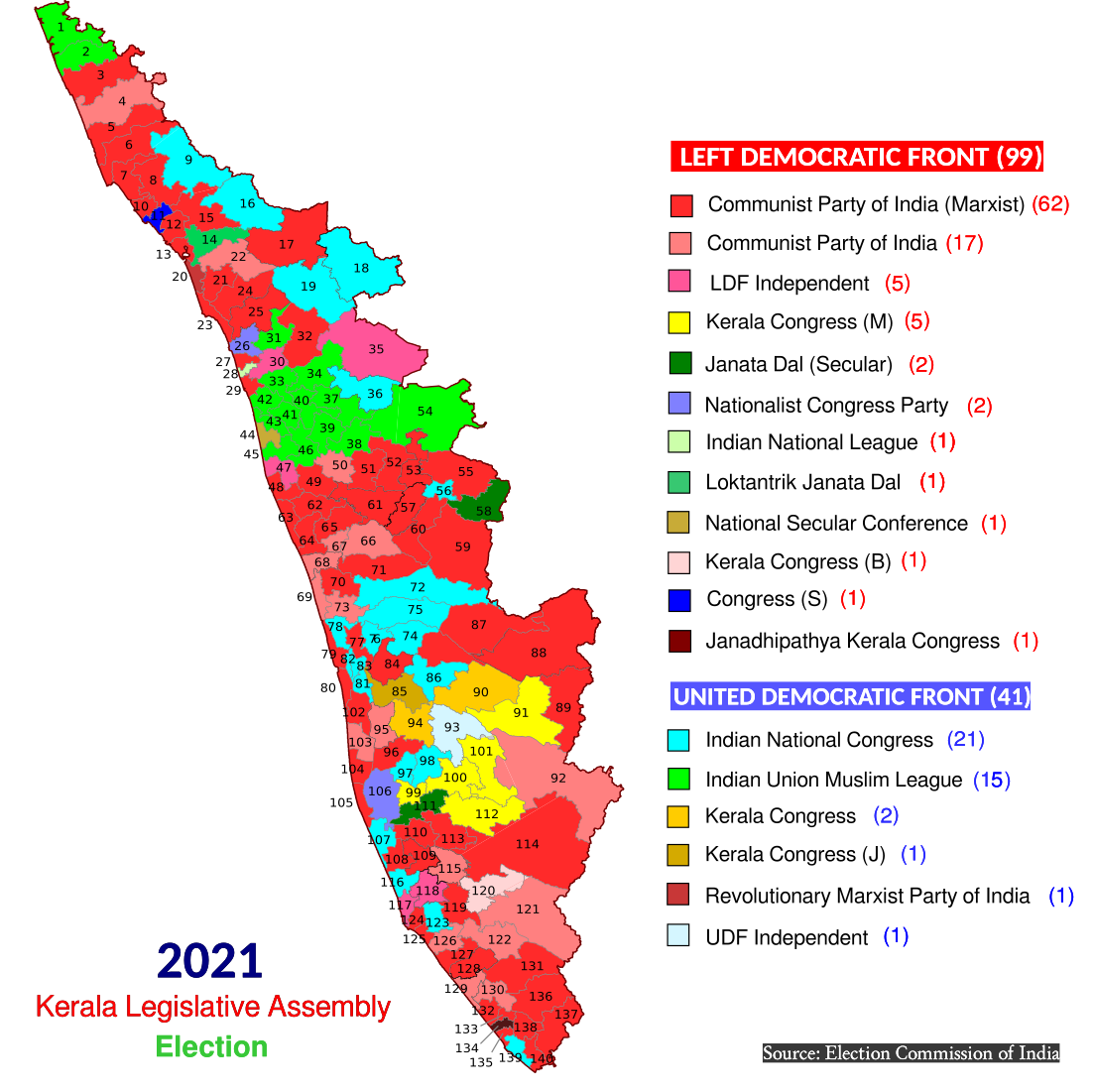
When the LDF won and returned to power in 2021, it was widely attributed to its handling of the Covid-19 crisis, particularly under the leadership of then Health Minister K.K. Shailaja. Yet, the same electorate that rewarded performance also questioned the decision of her removal from the cabinet. The electorate remained attentive to controversies and governance issues that followed. Therefore, political loyalty in Kerala is not fixed. Once the government earns it, it is re-evaluated. This shift shows how public support can change if the expectations are not met. The broader political landscape reinforces this pattern.
The BJP is also cautiously strengthening its presence in Kerala politics. It created history by winning its first ever parliamentary seat from Thrissur in the 2024 Lok Sabha election. This was followed by another breakthrough in the 2025 Local Body election, where they gained control of the Thiruvanathapuram Corporation, which was the LDF dominant area for the past 4 decades. And now in this Legislative Assembly election, the BJP won 3 seats.
What makes this culture even more striking is how early it takes shape. During my college days, campus politics was very visible and it remains so. Student organizations such as SFI, associated with the LDF ideology and KSU, aligned with the UDF, actively shaped political discussions on campus. My college was known as a “Chenkota”, a term used for campuses that consistently elect SFI representatives, symbolizing a “red fort.”
As an NCC cadet, we were not allowed to actively participate in student politics, but we had the duty of ensuring that the vote counting remained fair. Still, I witnessed how seriously students debated issues, defended ideologies and spoke with political conviction.
Kerala voters are known for their willingness to change power. Governments are rarely allowed to settle into complacency. No party in Kerala is free from criticism or controversies. Public memory remains sharp and vigilant. The past controversies continue to shape the electorate's present choices. While Kerala made history by democratically electing a communist-led government for the first time in Asia in 1957, it differed from that of Bengal and Tripura, which witnessed long uninterrupted Left governments. Instead, it has sustained a competitive political environment where power is regularly contested and redefined. The rivalry between the LDF and UDF is not just a political contest. It is a mechanism of accountability. This keeps governments responsive and voters engaged, ultimately benefiting the latter.
Thus this unique culture in Kerala politics is so compelling to outsiders. Kerala politics is about a society that treats politics as a daily practice, not a periodic obligation. The real meaning of democracy can often be seen here, where governments can genuinely change based on the will of the people.
*The Kautilya School of Public Policy (KSPP) takes no institutional positions. The views and opinions expressed in this article are solely those of the author(s) and do not reflect the views or positions of KSPP.
Rudraram, Patancheru Mandal
Hyderabad, Telangana 502329