
National Conference on
The Dynamics of False Cases
Kautilya School of Public Policy,
GITAM (Deemed to be University), Hyderabad
Concept Note
False cases are popularly understood as cases where allegations are made that are known to be untrue by the parties making them. They are usually understood as cases initiated by women, who make false allegations against others (usually men) either as a bargaining chip in another legal matter and/ or for some mala fide intent. The idea of false cases is connected to that of the misuse of law, which is gendered in the popular imagination: the laws that are seen as misused are those that exist to protect women, and women are seen as misusing these laws by filing false cases.
More recently, the association of false cases with other social groups has grown: for example, the draft UGC (Promotion of Equity in Higher Education Institutions) Regulations, 2025, which aims to prevent discrimination on the basis of religion, race, caste, sex, and place of birth, in institutes of higher education, also contains a section on false complaints, which would invite disciplinary proceedings against the complainant. (Update: the section on false complaints is absent from the final draft of the Regulations, which were published in January 2026.) The Protection of Children from Sexual Offences Act (POCSO) and the Scheduled Castes and the Scheduled Tribes (Prevention of Atrocities) Act are also seen as misused.
Nonetheless the current rhetoric around the idea of false cases is most associated with laws pertaining to dowry, cruelty, and rape. In this discourse, women are seen as wholly agential, able to use the law for whichever purposes they want. The rest of the edifice of the law and order machinery – the police, lawyers, courts, judges, procedures, evidentiary rules – are barely present in the current discourse. Also absent in this discourse is mention of the non- implementation of laws such as the Dowry Prohibition Act and Prohibition of Child Marriage Act.
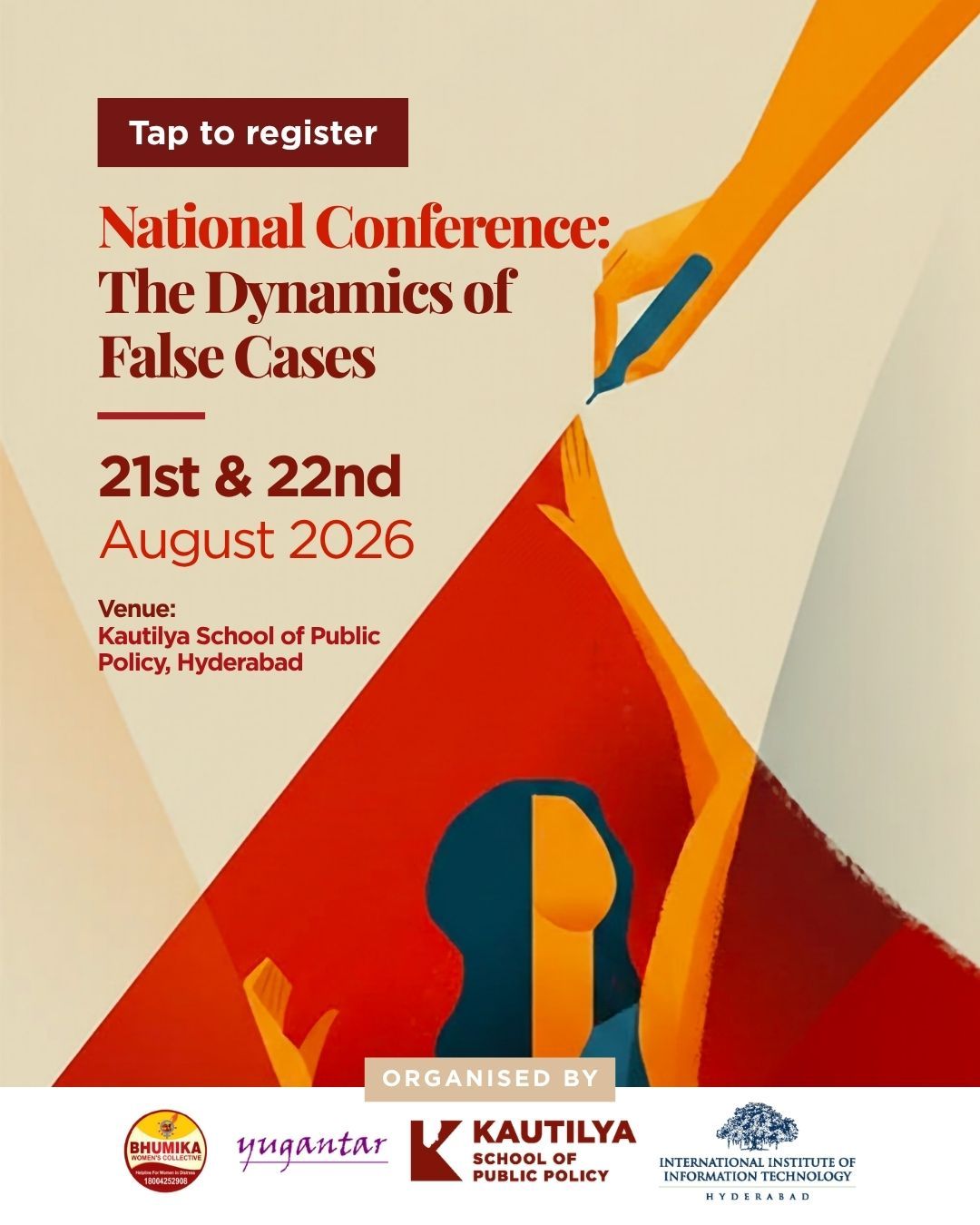
Despite the extensive and growing currency of the idea of false cases, there is little empirical knowledge or theorising on them. There is also little collective discussion on the topic and the impact it has on academic and community- based work. The Dynamics of False Cases conference will provide an opportunity for academics and practitioners to come together to learn and reflect upon the idea/phenomenon of false cases.
Tentative Themes
The discourse of false cases: What form does the discourse on false cases take? What themes, topics, and evidence does it focus on and what are its silences? On what platforms does it appear? What are the narratives in circulation? What solutions are offered? What types of offences or sections in law other than rape, cruelty and dowry are associated with false cases and misuse of law, and why?
The rhetoric of false cases: What do judges, lawyers, police and other authorities say about false cases and the misuse of law? What leads them to make these statements? How do these statements shape popular understandings? What role does the media play in shaping these perceptions? What understandings of gender, gender stereotypes etc. inform and underlie ideas of false cases and the misuse of law?
The history of debate around false cases: What is the academic discourse on false cases? In what context did this discourse/rhetoric of false cases or misuse of law appear in India? Which laws were being criticised specifically? Which social groups articulated such a criticism?
False case empirics: What are the realities of false cases? At what stage is a case termed false? How do empirical realities correspond to popular discourses on false cases? What role do legal provisions, or actors like lawyers, mediators, and the police play in shaping the specific allegations made in complaints? What leads people to make allegations that they know to be untrue?
The effects of false cases: What is the impact of popular understandings of the preponderance of certain cases being false? What is its impact on both the discourse on and specific cases of domestic violence, cruelty, rape, sexual harassment and violence against marginalised people?
False cases beyond India: What discourses and empirics of false cases and the misuse of law exist in other countries? What impacts have these discourses and empirics had on other jurisdictions/legal systems? How are such discourses and empirics addressed? How might discussions of false cases elsewhere inform debates in India?
Timeline
Submission deadline for abstracts
Communication of selection/rejection of abstracts
Presentation of selected abstracts (Online)
Communication of acceptance/rejection of abstracts
Submission deadline for drafts of papers
Feedback on draft papers
Submission deadline for revised papers
Conference FAQs
Submission Details
Word limit for abstract: 250–350 words
Word limit for paper: 3000–3500 words
PLEASE MAIL YOUR ABSTRACT TO
conference@kspp.edu.in
FOR CONTACT: conference@kspp.edu.in
Rudraram, Patancheru Mandal
Hyderabad, Telangana 502329